Any scan through a social media feed will show that there is a consistent pattern of participants being involved in activities with the main aim of an external audience. Purchases of kindness are published, manifestations of horror are liked, showcases of happiness are edited, and even a hiatus can be planned. This is an emergent feeling that online life is performed and is the cause of what scholars now call performative culture, social media, and a digital environment where the expression tends to be more focused on visibility than the true representation of oneself.
The question then comes to mind: why then does everything appear performative in online situations, and what does it mean to the ways we connect, care, and understand other people?
The Internet Turned Life into a Stage
Social media has not only offered a platform where people can share their lives, but it has also turned daily life into something that can be consumed. Social networks compensate for visibility, share worthiness, and emotional salience; likes, comments, and shares give their users a form of prompt feedback to subtly condition users to make curated self-presentations, which attract attention. The dynamic has gradually transformed the ideas of authenticity in online culture, leading people to question, Will this be welcome? Instead of, is this true to me? The resulting cycle filters purity with a set of strategic eye filters, and even pure emotions have become polished and put up before the market seems to be acting.
When Expression Becomes Performance
Online posting can be more of a presentation as compared to conventional communication. Proclaiming values, responding to news, or sharing of individual’s plight may seem carefully planned, refined, and aware of the crowd. This may not necessarily mean that there is deception; on the contrary, it helps in understanding the conscious knowledge of the audience following them. In this case, performative culture on social media is an emotionally exhausting experience, with omnipresent performance blurring true belief in the trend-following. The continual performance is not only oppressing to exist, but to be seen existing.
The Revolt of Performative Activism
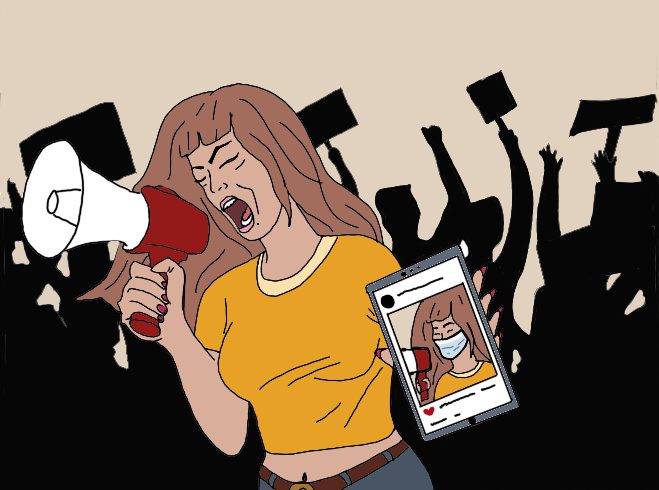
Activism is a field of online performance that is among the most disputed. One hashtag, a symbolic square made of black, or a reproduced infographic may be powerful, but it may seem empty the moment action stops. Modern literature on performative activism psychology explains the reasons why people publicly support causes without having to engage with them. Socially, social returns of public activism give psychological satisfaction of approval, belonging, moral validation, and a signal of compliance with what is considered right such positions. The dilemma arises when action culminates in posting; visibility becomes more important than responsibility, and activism becomes identity formation as opposed to influence. The awareness of this does not discredit the online activism, but emphasises the fact that optically-oriented activism can degenerate into branding instead of effecting real change.
Algorithms’ Performance, not depth, Rewarded
The social media platforms are not a non-partisan medium; they have an algorithmic focus that encourages users to scroll through the content by being highly emotional, outraged, virtue signalling, or dramatic. Nuance and subtleties are not favored, and they do not work. In turn, the authenticity y online culture realms is pushed to the extremes of exaggerating opinions, simplifying beliefs, and dramatizing emotions since subtlety is lost in the feed. The users gradually become aware that boasting is better than sincere expression. This paradox only enhances the phenomenon: the more one has to share it, the less it appears to be real.
The Fear of Being Invisible
The main fear that is the underlying problem of online performance is a deep human fear, a fear of invisibility. Social media promises interconnectedness and, at the same time, provides competition in terms of attention. Silence can also be seen as be failure when validation is publicly measurable. It is this anxiety that forms the basis of performative culture on social media, which is fueled by the urge to post not just to communicate but to manifest presence, concern, and importance. Even the vulnerable can be transactional in such an environment, not to provide support but to participate. Ironically, the more people act to get attention, the less they have people to associate with.
Are We Being Stripped of Real Authenticity?
The issue of authenticity on the Internet is not completely erased, but it is opaque. When all the posts look refined and all the poses practiced, honesty is aroused. It is people who begin to doubt not only others but themselves as well. This more insidious threat, which is examined in performative activism psychology as well as digital behaviour studies, is indicative of the fact that continuous performance obscures the distinction between a sincere belief and a social expectation. In a span of time, people could forget what they believed in as compared to the actions they have learnt to project.
Discovering a Significance Beyond Competitiveness
Not all internet communication is artificial. Authenticity continues: people are sincere, tell the truth, and act in a good way. The issue is being overexposed, meaning the loss of meaning to the public. To restore the authenticity of online culture, it might be necessary to start with small, less noticeable steps: personal chatting, offline campaigns, and pauses before posting. Not all beliefs are presupposed by an audience, all feelings by a caption. The reality is that very often the most authentic experience is one that fails to fare well on standard measures.
Final ThoughtsEverything is performative on the internet since the internet brings about the institutionalisation of performance. Visibility acts as currency, whereby genuineness is forced to take on performance masks to survive. In a topography created by performative culture, social media online culture, and the pressures explored in performative activism psychology. With the help of orientation through the strains of performative activism, psychology, and digital behaviour studies, one can withstand a complete loss of authenticity and remain with a base of authentic interest.