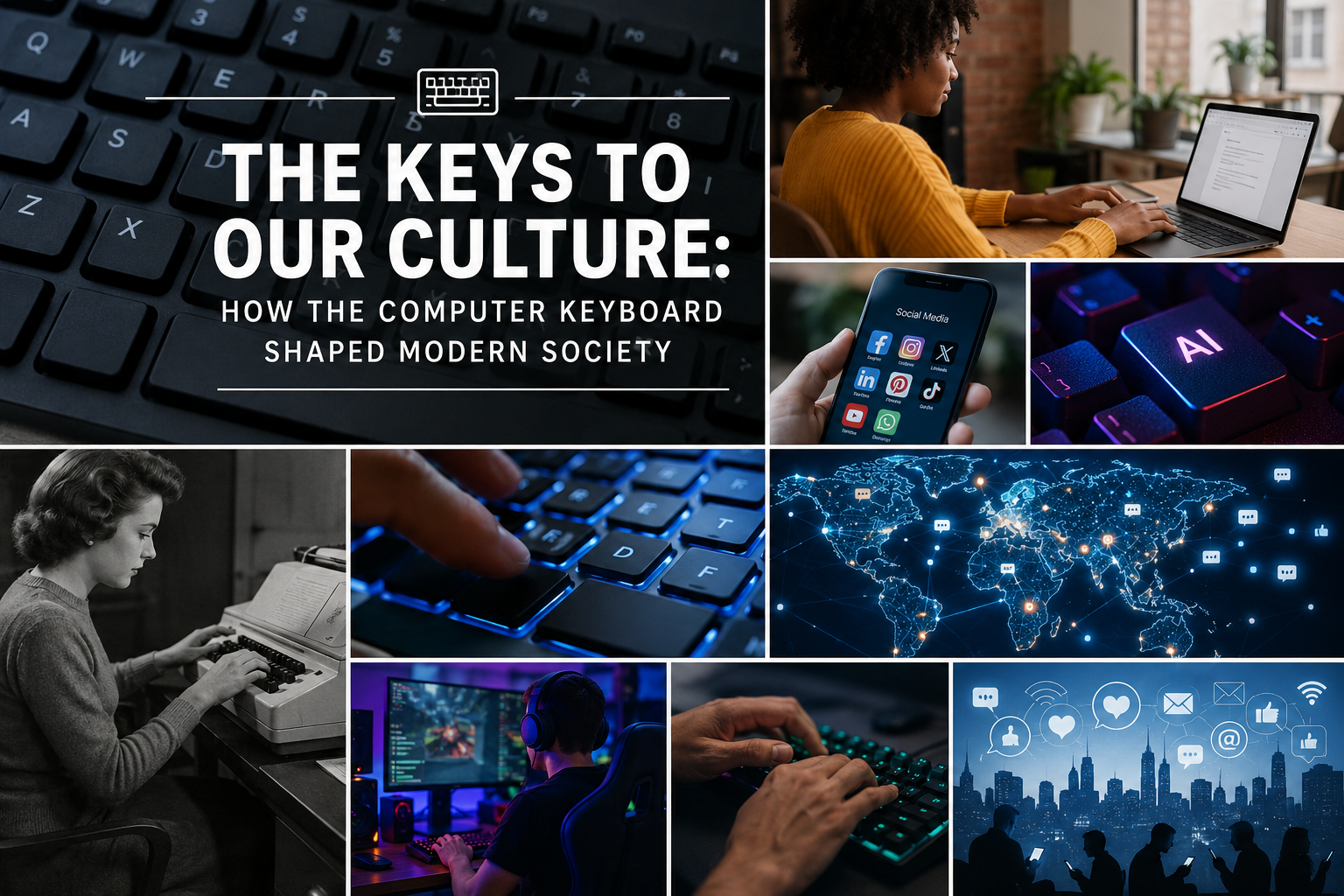
Look down at your desk. Or, if you are reading this on a phone, look at the bottom half of your glowing glass screen. The computer keyboard—whether rendered in clacking plastic, sleek brushed aluminum, or haptic digital glass—is the undisputed primary conduit of human expression in the 21st century.
For decades, the keyboard was viewed simply as a utilitarian input device, a beige peripheral tethered to the “real” computer. Yet, its cultural impact is profound. The keyboard has not merely recorded modern history; it has fundamentally altered how we communicate, how we work, how we form communities, and even how we think. By transforming the barrier between human intent and digital execution into a series of rapid-fire keystrokes, the keyboard has quietly engineered a revolution in human society.
The QWERTY Artifact: A Shared Global Muscle Memory
To understand the cultural weight of the keyboard, one must first look at its most enduring legacy: the QWERTY layout. Invented in the early 1870s by Christopher Latham Sholes for the Sholes and Glidden typewriter, the QWERTY arrangement was famously designed to separate commonly paired letters (like ‘S’ and ‘H’ or ‘T’ and ‘H’) to prevent the mechanical typebars from jamming.
This 19th-century mechanical workaround has become one of the most resilient cultural artifacts in human history. We no longer use mechanical typebars, yet QWERTY persists across laptops, tablets, and smartphones globally. It represents a universal muscle memory shared by billions. When you sit at a keyboard, your fingers instinctively know where the letters live. This shared physical knowledge is a silent, unifying human behavior. The layout is so deeply ingrained in our collective psyche that attempts to introduce more ergonomically efficient layouts—like the Dvorak Simplified Keyboard—have largely failed, not because they are mechanically inferior, but because QWERTY has become a deeply entrenched cultural standard.
The Speed of Thought and the New Digital Voice
Before the widespread adoption of the computer keyboard, writing was a deliberate, often slow process. Handwriting requires physical exertion and time, naturally enforcing a slower pace of thought. The typewriter sped things up, but errors were costly, and revisions were arduous.
The computer keyboard, paired with the word processor and the glorious “Backspace” key, removed the friction from writing. Suddenly, humans could type at speeds approaching their actual stream of consciousness—often ranging from 40 to 80 words per minute, with some reaching well over 100. This raw speed birthed a completely new form of written communication: conversational writing.
Historically, written text was formal and premeditated. The keyboard democratized the casual voice. It enabled the rapid-fire exchange of emails, the real-time banter of instant messaging, and the ephemeral thoughts of social media. We began to write exactly as we speak. This shift gave rise to digital body language. We learned to convey tone through keystrokes: the aggressive shouting of ALL CAPS, the casual indifference of completely lowercase sentences, or the passive-aggressive weight of a perfectly placed, single period. The keyboard allowed text to carry the emotional nuance of spoken dialogue.
The Subculture of Switches: The Mechanical Renaissance
For a long period in the 1990s and 2000s, the keyboard suffered a design recession. The pursuit of cheaper, thinner laptops led to the dominance of “membrane” and “chiclet” keyboards—devices that felt mushy and uninspiring.
However, over the last decade, a massive cultural counter-movement has exploded: the mechanical keyboard renaissance. Triggered in part by the 2014 expiration of patents on the beloved Cherry MX mechanical switch, an entirely new subculture emerged. Today, keyboards are no longer just office supplies; they are bespoke instruments of self-expression.
This community treats keyboards with the same reverence audiophiles give to vintage speakers, or gearheads give to sports cars. Enthusiasts spend hours “lubing” tiny plastic switches to achieve the perfect acoustic signature—seeking a deep, resonant “thock” or a sharp, satisfying “clack.” Keycaps are produced in limited-run group buys, featuring colorways inspired by everything from 1980s synth-wave to Japanese minimalist art.
This movement highlights a cultural craving for tactility. In an era where our lives are increasingly dominated by smooth, featureless glass touchscreens, the mechanical keyboard offers physical feedback. It provides a satisfying, tangible confirmation of our actions. The keyboard has transformed into a highly personalized canvas, an extension of the user’s aesthetic and identity.
Gamers, Hackers, and the Visual Language of RGB
The cultural impact of the keyboard is perhaps most visible in the gaming and hacker communities. In the realm of PC gaming, the keyboard is the steering wheel, the trigger, and the command center. The infamous “WASD” cluster has replaced the directional arrows as the universal symbol for movement in digital worlds.
Gaming culture also introduced the world to RGB backlighting. What started as a functional feature to help users see keys in the dark quickly evolved into a loud, pulsing aesthetic. The glowing, color-shifting keyboard has become the defining visual trope of the modern “gamer” aesthetic, heavily influencing the design of laptops, mice, and even the interior lighting of modern cars.
Simultaneously, the keyboard remains the ultimate symbol of the hacker and the programmer—the modern wizards who write the code that runs our world. In popular media, the sound of furious typing in a dark room is the universal shorthand for hacking into a mainframe or writing a world-changing algorithm. The keyboard is the tool of digital creation, a symbol of agency in a technology-driven world.
The Future of the Keystroke
As we look to the future, the dominance of the physical keyboard is constantly questioned. Voice-to-text dictation is incredibly accurate. Virtual reality relies on spatial gestures. Companies are developing brain-computer interfaces that may one day allow us to control computers with pure thought.
Yet, the keyboard refuses to die. It survives because it offers a unique combination of speed, precision, and privacy that voice dictation simply cannot match in a crowded office or a quiet coffee shop. It survives because there is an inherent, psychological satisfaction in the physical act of striking a key to make a thought real.
The computer keyboard has shaped our posture, dictated the evolution of human language, and democratized the ability to publish thoughts to the world. It is the bridge between the biological and the digital. Long after we have developed new, futuristic ways to interact with our machines, the keyboard will be remembered as the artifact that taught humanity how to speak to the digital world—one click at a time.