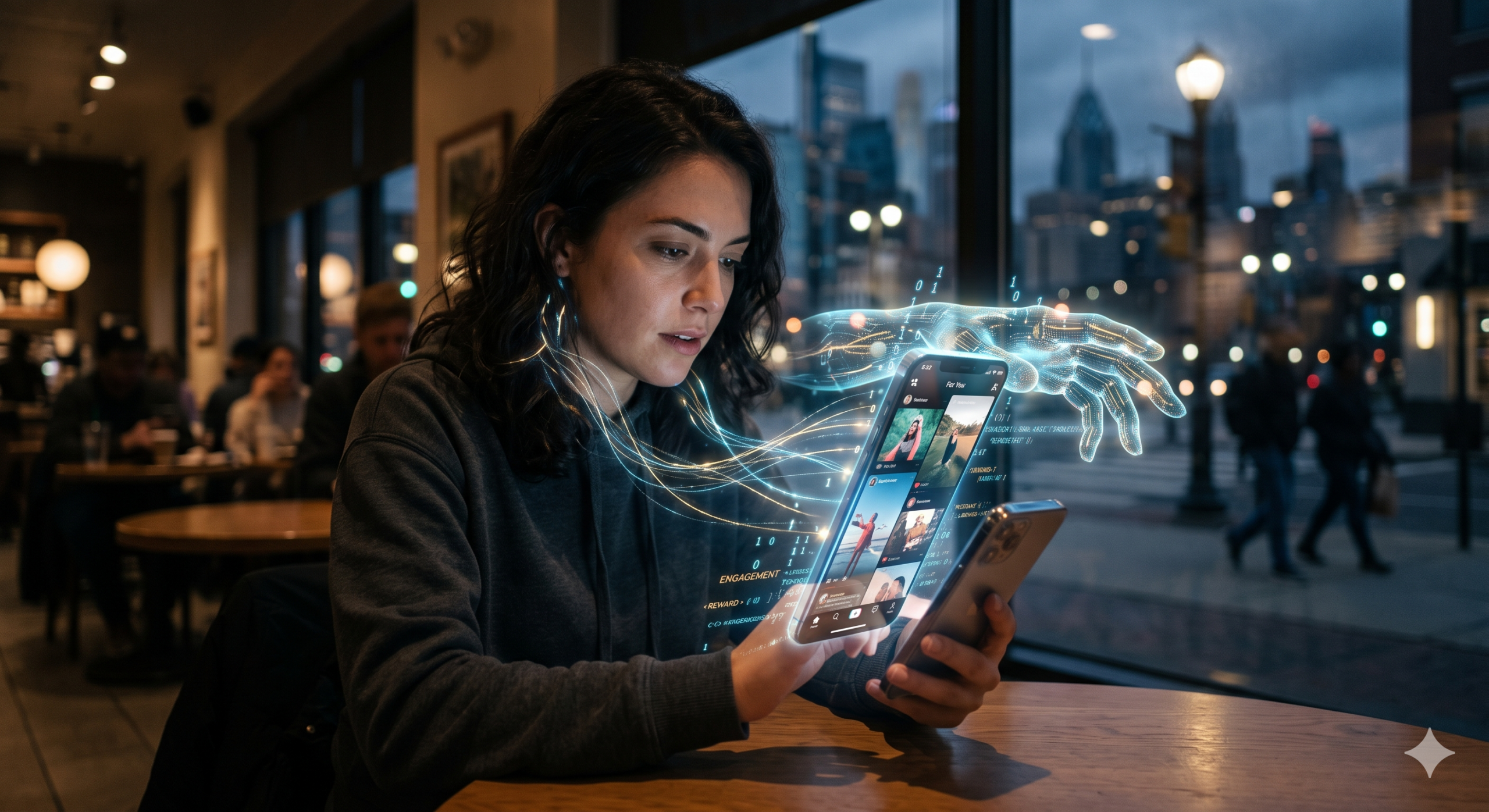
The modern digital experience has undergone a quiet but profound transformation. We have shifted from being active seekers of information to passive consumers of curated realities. At the heart of this shift is the algorithmic feed — the recommendation engines powering our social media platforms, video networks, and news aggregators. These systems operate as an invisible hand, subtly shaping human decision-making, manufacturing consumer habits, and fundamentally altering voter behavior.
In this exclusive, we examine how these algorithms bypass conscious choice, the implications for independent journalism, and what it means for the future of human intent in an increasingly synthetic media landscape.
The Architecture of Persuasion
To understand how algorithms influence behavior, we must first look at their underlying prime directive: engagement. Recommendation engines are not designed to inform, educate, or elevate human consciousness; they are optimized to maximize the time spent on a platform. Every scroll, pause, click, and comment is harvested to build a hyper-specific behavioral profile.
This architecture fundamentally alters consumer habits. In the past, purchasing decisions were largely driven by conscious intent or direct, localized advertising. Today, algorithms predict and manufacture desire before the consumer even consciously recognizes it. By analyzing millions of micro-interactions, platforms can serve a targeted advertisement, a perfectly timed influencer video, or an integrated product placement at the exact moment a user is most psychologically susceptible.
This creates a closed-loop system of consumption. The algorithm feeds the user what it predicts they want, the user engages, and the algorithm reinforces its own model. The result is a frictionless funnel where the cognitive load of critical thought is entirely removed from the purchasing process. We are no longer buying products; we are buying the algorithm’s projection of who we are.
Rewiring the Voter: The Fragmentation of Reality
While the manipulation of consumer habits is lucrative, the impact of algorithmic curation on political behavior is far more consequential. News aggregators and social feeds have dismantled the shared baseline of reality that once anchored democratic discourse.
When voters open their feeds, they do not see a neutral landscape of current events. They see a mirror reflecting and amplifying their pre-existing beliefs. Algorithms heavily weight content that triggers high-arousal emotions — specifically outrage, fear, and tribal validation. Nuanced, independent journalism rarely triggers the same immediate neurological reward as a sensationalized, hyper-partisan headline.
Consequently, the invisible hand guides voters into increasingly isolated echo chambers. Over time, this constant diet of ideologically skewed information alters the baseline of what users consider normal or acceptable. The decision of who to vote for, or whether to vote at all, is no longer purely the result of conscious deliberation. It is heavily influenced by the volume, velocity, and emotional resonance of the curated reality served to them.
For independent media striving to maintain journalistic integrity, this presents an existential challenge. How does factual, objective reporting break through a distribution network fundamentally rigged to favor polarization?
The Synthetic Future: AI and Algorithmic Curation
The challenge is accelerating as the media landscape shifts from purely human-created content to synthetic media. As generative AI becomes integrated into content pipelines, the algorithms dictating our feeds are no longer just curating existing content — they are interfacing with systems capable of generating it on the fly.
If an algorithm knows that a specific demographic of voters responds to a certain type of visual rhetoric, generative models can now flood the zone with hyper-targeted, synthetic articles, images, and videos. This combination of algorithmic distribution and synthetic generation is the ultimate test of human perception. When a news aggregator can serve a feed where the content is both algorithmically selected to manipulate your bias and synthetically generated to bypass your critical faculties, the concept of independent thought is under siege.
The Erosion of Conscious Choice
At a deeper level, the pervasive influence of algorithmic feeds forces us to confront uncomfortable questions about human consciousness and agency. When our media diet is entirely mediated by machine learning models, where does the algorithm end and our independent intent begin?
We are witnessing a subtle outsourcing of cognition. By allowing algorithms to dictate our daily flow of information, we surrender the labor of discovery. This continuous algorithmic nudging shapes not just what we buy or how we vote, but how we perceive the world and our place within it. The line between organic human thought and technologically induced preference is blurring.
Reclaiming Human Intent
The solution is not to outright reject digital technology — such a retreat is neither practical nor desirable in a hyper-connected world. Instead, the path forward requires a conscious re-engagement with our media consumption.
Reclaiming human intent begins with recognizing the invisible hand for what it is: a tool of optimization, not a reflection of reality. It requires actively supporting independent journalism that operates outside the algorithmic incentive structure. Readers must intentionally seek out diverse perspectives, manually disrupting the frictionless feeds designed to keep them complacent.
Ultimately, the battle for human agency in the digital age will not be fought in the courts or Congress alone, but in the daily, micro-decisions of every individual interacting with a screen. The algorithms may deal the cards, but we must remember that we still retain the power to choose how to play the hand.
A Merged Insight Exclusive.