
To look upon the American Republic today is to witness a magnificent, high-tech engine running at maximum RPM. At the same time, its mechanics argue furiously over who gets to hold the steering wheel—all while ignoring the smoke billowing from under the hood. The Republic is not on the verge of collapse; rather, it is locked in a state of hyper-dynamic stasis. It is wealthier, more technologically dominant, and more militarily formidable than any empire in history. Yet, itstory, yet it is simultaneously plagued by profound internal cynicism, systemic financial over-leveraging, and a citizenry increasingly alienated by the very systems designed to protect them.
This is an examination of a nation caught between its foundational myths and its current realities. It is a subjective look at the fractures in our politics, the weight of our collective debt, the unseen contracts that govern our lives, and the global chess game the Republic plays to maintain its precarious perch.
The Tribal Theater: Political Factions and the Industry of Infighting
Modern American politics is no longer about governance; it is an optimization problem for engagement. The political factions that dominate the landscape have evolved from traditional ideological coalitions into high-margin media franchises designed to monetize outrage and weaponize identity.
The Duopoly of Distraction
The two major political factions operate less like philosophical movements and more like rival corporate entities competing for market share in the attention economy.
- The Progressive-Technocratic Wing: This faction views the Republic as an incomplete project requiring constant intervention, regulatory oversight, and cultural re-engineering. It champions a future driven by centralized expertise, algorithmic fairness, and systemic restructuring. However, its Achilles’ heel is a persistent elitism and an obsession with linguistic and cultural purity that frequently alienates the very working-class demographics it claims to champion.
- The Populist-Nationalist Wing: This faction positions itself as the defensive shield of a fading American heritage, leveraging a potent mix of nostalgia, skepticism of centralized power, and working-class grievance. It thrives on disruption and anti-establishment rhetoric. Yet, its challenge lies in a frequent lack of coherent policy alternatives, often substituting symbolic culture-war victories for structural economic reforms.
The Machinery of Infighting
The genius of the current system is that internal infighting acts as a pressure valve, keeping the citizenry focused on horizontal conflicts (neighbor against neighbor) rather than vertical conflicts (the public against the institutional architecture).
The Outrage Loop: A politician makes a provocative statement $rightarrow$ Cable news dissects it for 48 hours $rightarrow$ Social media algorithms amplify the most extreme reactions $rightarrow$ Both political parties use the controversy to fundraise $rightarrow$ No actual legislation is passed.
This perpetual conflict is highly profitable. It sustains cable news networks, funds political action committees (PACs), and provides content for social media platforms. The casualty of this industry is the collective American psyche, which is left exhausted, paranoid, and thoroughly convinced that the “other side” poses an existential threat to civilization.
The Phantom Ledger: Debt, Currency, and the Economics of Yesterday
If politics is the theater of the Republic, the national debt is the reality broadcast playing in the background that everyone has agreed to mute. The numbers have long since transcended human comprehension, entering the realm of abstract mathematics.
       [ Federal Spending ]
               │
               â–¼
     [ Tax Revenue Shortfall ]
               │
               â–¼
   [ Treasury Bond Issuance ] ──► [ Federal Reserve Monetization ]
               │
               â–¼
    [ Expansion of Money Supply ] ─► [ Systemic Asset Inflation ]
The $34+ Trillion Mirage
The American financial strategy for the past several decades has resembled an elite college student living indefinitely off a credit card with an infinite limit and a floating interest rate. The national debt is no longer a metric to be managed; it is a permanent feature of the macroeconomic landscape.
- The Weaponization of the Dollar: The Republic enjoys the “exorbitant privilege” of issuing the world’s primary reserve currency. Because global trade—particularly the energy sector—is denominated in U.S. dollars, the United States can effectively export its inflation to the rest of the world.
- The Compound Interest Trap: The true crisis is not the principal of the debt, but the cost of servicing it. As interest rates normalize to combat inflation, the line item for “interest on the national debt” threatens to eclipse the entire defense budget, creating a feedback loop where the government must borrow money simply to pay the interest on the money it previously borrowed.
This structural reality means that neither political faction can ever truly balance the budget. To drastically cut spending would trigger a massive economic depression; to raise taxes sufficiently would paralyze capital markets. Thus, the choice is made to print, borrow, and inflate, slowly eroding the purchasing power of the currency while maintaining the illusion of prosperity.
The Invisible Ledger: Contractual Existence and Societal Enslavement
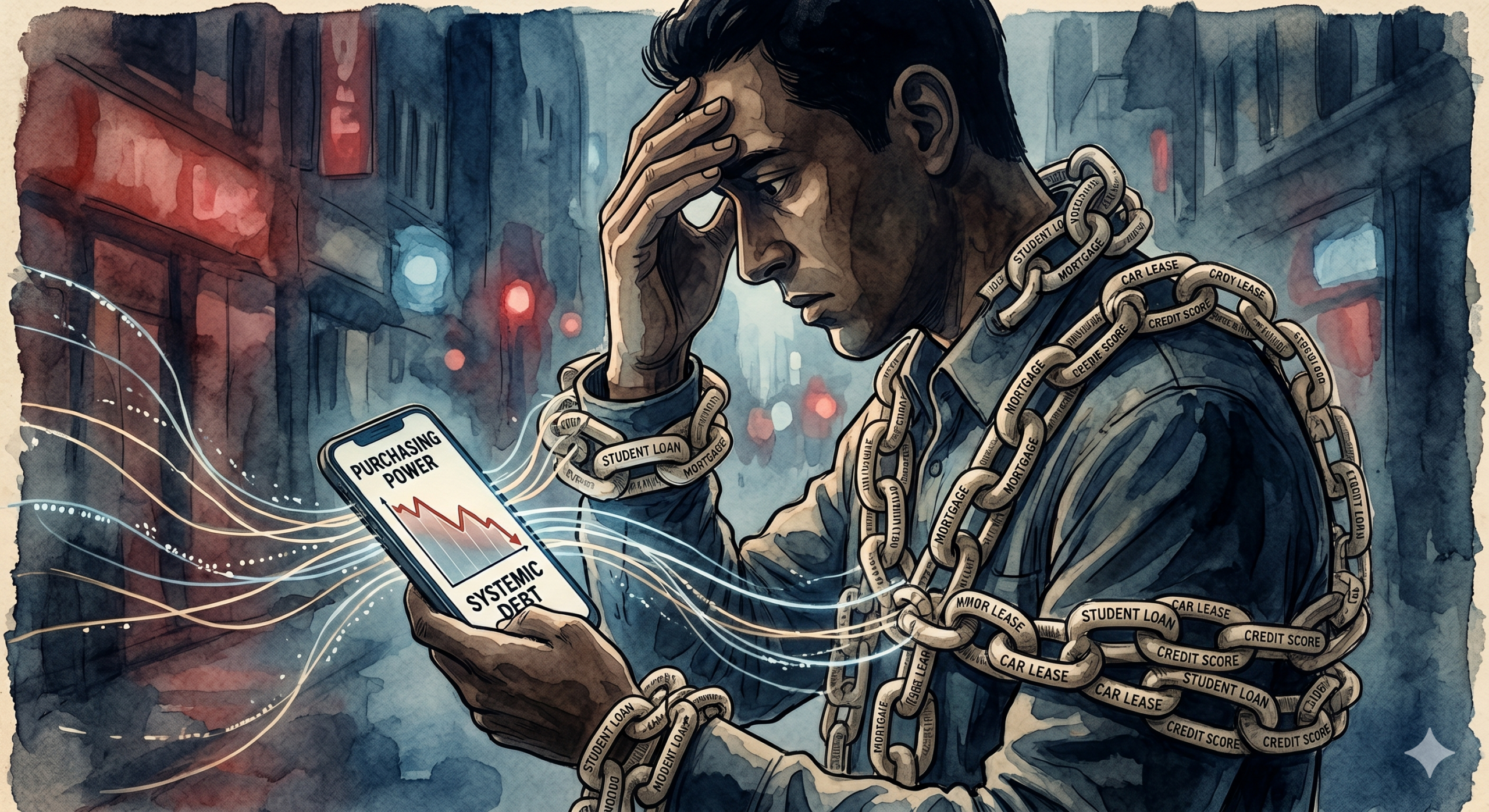
Beyond the macroeconomic numbers lies a more intimate, quiet crisis: the subtle transformation of the American citizen from a free stakeholder in a republic into a contractual unit of a corporate-state apparatus. This isn’t achieved through overt tyranny, but through a web of financial, digital, and legal dependencies.
The Subscription Model of Human Life
The modern American economy has largely transitioned from ownership to stewardship. Citizens rarely own their assets; they rent them, lease them, or finance them under strict contractual terms.
- The Debt-To-Work Cycle: The path to middle-class normalcy is paved with systemic debt. Higher education requires student loans that cannot be discharged in bankruptcy; housing requires 30-year mortgages that tie labor to specific geographic and economic hubs; reliable transportation requires compounding auto loans or leases.
- The Minimum Wage Illusion: While nominal wages fluctuate and debates over the legal minimum wage dominate headlines, the real metrics—the cost of housing, healthcare, and basic nutrition—continue to outpace real wages. The result is a population that must work at maximum capacity simply to maintain baseline stability, leaving little temporal or intellectual capital for civic engagement or political resistance.
The Digital Panopticon
This contractual framework is reinforced by the ubiquity of smartphone technology and algorithmic ecosystems. The modern citizen has voluntarily signed end-user license agreements (EULAs) that trade personal data, behavioral metrics, and privacy for convenience and dopamine.
[ User Interaction ] ──► [ Data Harvested via EULA ] ──► [ Algorithmic Profile ] ──► [ Behavioral Steering ]
This digital architecture serves as an incredibly effective mechanism for social stabilization. A population that is constantly stimulated, hyper-targeted by consumer algorithms, and economically bound to an intricate web of credit scores and recurring monthly payments is a population that is fundamentally risk-averse. The ultimate effect is a quiet, comfortable compliance—a state where individuals are too indebted to quit their jobs, too distracted to organize, and too dependent on the system to risk its disruption.
Pax Americana’s Shield and Sword: Defensive and Offensive Stratagems
Despite its internal political fragmentation and financial fragility, the American Republic remains an absolute titan on the global stage. Its foreign policy and military doctrines are designed to ensure that internal domestic instability never compromises its external dominance.
1. The Defensive Stratagem: Fortress America and Hemispheric Monopoly
The primary defensive strategy of the United States is geographic and structural. It is an implementation of the Monroe Doctrine updated for the 21st century.
- Geographic Insularity: The Republic is bordered by two vast oceans and two deeply integrated, non-threatening neighbors. This geographic luxury makes physical invasion practically impossible, allowing the nation to focus its defensive capital on border security, cyber-defense, and intelligence infrastructure.
- The Cyber Shield: The defensive frontline has shifted from physical borders to the digital ether. The Republic invests heavily in securing critical infrastructure—the power grid, financial networks, and communication arrays—against state-sponsored cyber actors. This is a quiet, unceasing conflict fought in the shadows of the dark web and secure server farms.
2. The Offensive Stratagem: Network Centric Hegemony and Power Projection
Offensively, the Republic does not seek to conquer territory; it seeks to control the global commons. Its strategy is built around three pillars:
┌──────────────────────────────â”
│ U.S. GLOBAL POWER PROJECTION │
└──────────────┬───────────────┘
│
┌───────────────────────┼───────────────────────â”
â–¼ â–¼ â–¼
┌─────────────────┠┌─────────────────┠┌─────────────────â”
│ Maritime Control│ │ Financial Swift │ │ Cognitive and │
│ (11 Carrier │ │ Sanctions │ │ Cultural Media │
│ Strike Groups) │ │ Architecture │ │ Dominance │
└─────────────────┘ └─────────────────┘ └─────────────────┘
- Blue-Water Naval Supremacy: The U.S. Navy acts as the guarantor of global maritime trade. By maintaining 11 nuclear-powered aircraft carrier strike groups, the Republic can project overwhelming kinetic power to any coastline on Earth within hours. This control of the seas ensures that global supply chains remain open or closed entirely at the discretion of the United States.
- Economic Chokeholds: The offensive capability of the U.S. Department of the Treasury is often more potent than the Pentagon. Through control of the SWIFT banking network and dollar-denominated global clearing houses, the Republic can effectively excise recalcitrant nations from the global economy. Sanctions are the modern equivalent of a medieval siege, devastating domestic economies without firing a single shot.
- Cognitive and Cultural Power Projection: The American export is not just goods, but narratives. Through Hollywood, Silicon Valley platforms, and global media distribution networks, the Republic shapes the cultural aspirations, values, and political paradigms of the global population. This soft power ensures that even rivals operate within a cultural landscape largely defined by American imagination.
The Horizon of the Republic
The state of the American Republic is a study in profound contradictions. It is a nation fractured by curated political tribalism, anchored by an astronomical mountain of debt, and populated by citizens navigating a deeply transactional, contractual existence. Yet, externally, it possesses an unparalleled capacity for power projection and global leverage.
The true test of the Republic will not be whether it can defeat external adversaries, but whether its internal institutional architecture can withstand the strain of its own domestic contradictions. The engine is still running, the gears are still turning, and the spectacle continues. The future of the American experiment depends entirely on whether its people realize that the true strength of a republic lies not in the perfection of its systems, but in the collective consciousness, shared grace, and clear-eyed vigilance of its citizens.
A Merged Insight Exclusive.