
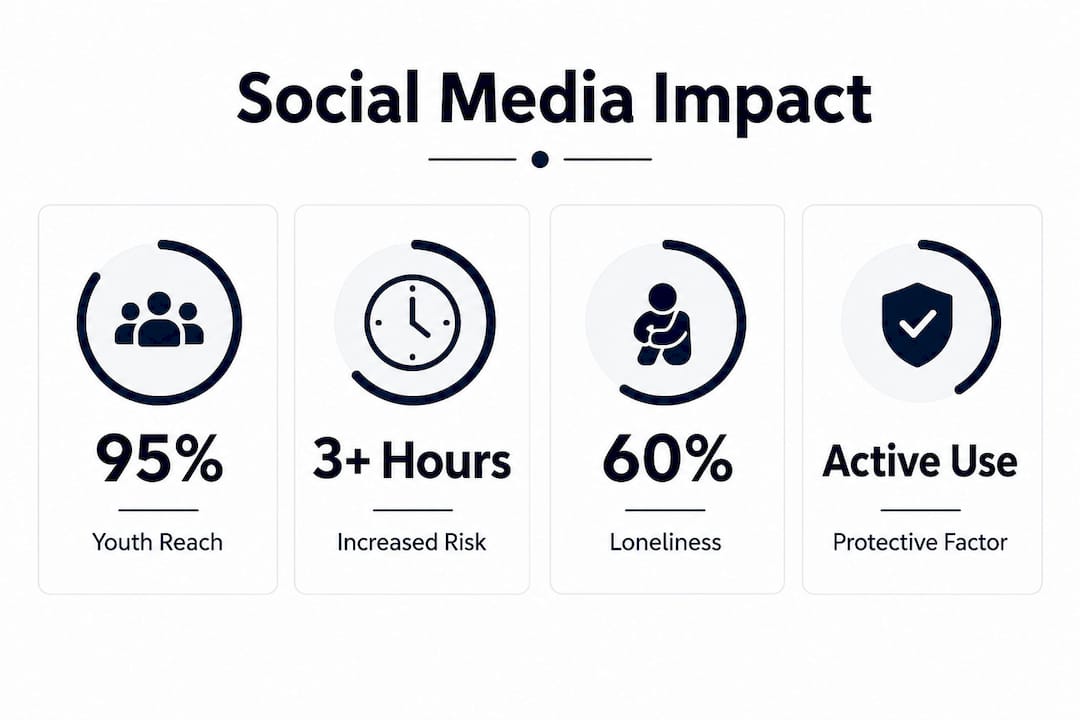
Social media significantly harms mental health for many users, particularly adolescents, while also offering genuine benefits for community and support. The evidence is no longer ambiguous. Adolescents who spend more than 3 hours daily on social media face double the risk of depression and anxiety symptoms, and a recent survey found teenagers average 3.5 hours per day on these platforms. At the same time, a systematic review covering 182 studies with over 1.1 million participants confirms that problematic social media use is consistently linked to depression, anxiety, and disrupted sleep. The picture is complex, not simple, and that complexity demands serious attention.
- Adolescents face the highest risk, with heavy use linked to depression, anxiety, and body image distress.
- 46% of adolescents aged 13–17 report that social media makes them feel worse about their bodies.
- Social media can also provide vital peer support, identity affirmation, and community, especially for marginalized youth.
- Longitudinal and meta-analytic research confirm causal relationships, not just correlations, between heavy use and mental health changes.
- The U.S. Surgeon General has called social media a meaningful risk to youth well-being, while acknowledging its benefits.
The core challenge is that social media’s impact on mental health is neither uniformly destructive nor benign. It depends on who is using it, how, and for how long.
How social media affects mental health across different age groups
The relationship between social media and mental health does not look the same at every stage of life. Age, developmental stage, gender, and socioeconomic status all shape how platforms affect well-being, and the research reflects that variation clearly.
Adolescents: the most vulnerable group
Adolescents bear the greatest burden. The U.S. Surgeon General’s advisory reports that up to 95% of young people aged 13–17 use at least one social media platform, with nearly two-thirds using it every day and one-third reporting they are on it “almost constantly.†That level of exposure, during a period of intense neurological and emotional development, creates conditions where harmful content and social comparison can do lasting damage.
Longitudinal data from 2,350 adolescents show that social media use beyond 3 hours daily correlates with increased depressive and anxiety symptoms, with sleep disruption acting as a major mediating pathway. Girls tend to experience stronger negative effects than boys, partly because platforms like Instagram amplify appearance-based social comparison. Socioeconomic disadvantage compounds the risk: youth with fewer offline resources often rely more heavily on social media for connection, increasing exposure while having less access to mental health support.
| Age Group | Primary Risks | Moderating Factors |
|---|---|---|
| Children under 13 | Exposure to inappropriate content, early habit formation | Parental oversight, platform age restrictions |
| Adolescents 13–17 | Depression, anxiety, body image distress, sleep disruption | Gender, daily usage hours, content type |
| Young adults | FOMO, loneliness, academic stress amplification | Active vs. passive use, offline social support |
| Adults | Misinformation exposure, political stress, comparison | Use purpose, digital literacy, time boundaries |
Children under 13
Children under 13 increasingly access platforms like TikTok, Instagram, and Facebook despite age restrictions, often with limited parental awareness. Their developing brains are particularly susceptible to reward-loop mechanics built into platform design. Early exposure to curated, idealized content can set distorted benchmarks for self-worth before children have the cognitive tools to critically evaluate what they are seeing.
Adults
Adults are not immune. Passive scrolling on Facebook or Instagram tends to increase feelings of inadequacy and loneliness, while active engagement, such as direct messaging or participating in interest-based groups, is associated with better outcomes. The complex relationship between social media and mental health means that adults with pre-existing anxiety or depression may find platforms amplify those conditions, while others use the same tools to build genuine community.
What social media actually gets right for mental health
The public conversation about social media and mental health often skews toward harm, and the harms are real. But dismissing the benefits entirely misrepresents the evidence and leaves out the people for whom these platforms serve a genuine protective function.
- Peer support and help-seeking: Social media enables people to find others with shared experiences, reducing the isolation that often accompanies mental health struggles. For someone in a rural area with limited access to in-person support groups, an online community can be a lifeline.
- Identity affirmation for marginalized youth: LGBTQ+ adolescents, young people with disabilities, and those from minority communities often find social media platforms provide spaces where their identities are affirmed and celebrated rather than stigmatized. Research from Johns Hopkins confirms that moderate social media use can buffer stress and affirm identity for these groups.
- Access to mental health information: Platforms like TikTok and Instagram have become significant channels for mental health education. Psychologists, therapists, and advocates share evidence-based content that reaches people who might never seek formal care.
- Expression and creative outlet: Writing, art, music, and video creation shared on social platforms give people a constructive channel for processing difficult emotions. Active, creative engagement is consistently linked to better psychological outcomes than passive consumption.
- Community during crisis: During periods of social isolation, such as the COVID-19 pandemic, social media provided connection that partially offset the mental health toll of physical distancing. The platform, in those circumstances, functioned as infrastructure.
The critical variable is engagement mode. Active, intentional use, where someone is creating, connecting, or seeking specific information, tends to produce better mental health outcomes than passive, aimless scrolling. That distinction matters more than total time on screen in many cases.
How you can use social media more safely
Reducing harm from social media does not require deleting every app. It requires deliberate choices about when, how, and why you engage. The research points to several strategies that consistently produce measurable improvements.
Pro Tip: There is no universal “safe†number of daily minutes on social media. Dr. Jennifer Katzenstein of Johns Hopkins explains that the right amount depends on your individual developmental stage, protective factors, and how the use makes you feel. Track your mood before and after sessions to find your personal threshold.
- Set firm time limits. A meta-analysis of 35 experiments with 7,160 participants found that restricting social media use produces significant improvements in depression, anxiety, and body image. Even modest reductions produce measurable gains.
- Protect your sleep. Longitudinal evidence shows that sleep disruption is a primary mechanism through which heavy social media use worsens depression and anxiety. Set a hard cutoff at least 60 minutes before bed, and charge your phone outside the bedroom.
- Turn off non-essential notifications. Constant pings train compulsive checking behavior. Disabling notifications for social apps reduces the psychological pull to engage outside of intentional sessions.
- Create phone-free zones. Designating spaces, such as the dinner table, bedroom, or the first hour after waking, as phone-free reduces ambient exposure and creates natural recovery time.
- Audit who you follow. Accounts that consistently trigger comparison, inadequacy, or anxiety deserve to be unfollowed, regardless of how popular or informative they appear. Your feed is an environment you can shape.
- Prefer active over passive use. Commenting, creating, and direct messaging tend to produce better outcomes than scrolling. When you open an app, have a purpose.
- Use platform tools. Instagram, TikTok, and Facebook all offer built-in screen time dashboards and usage reminders. They are imperfect, but they create friction that can interrupt automatic scrolling.
What platforms need to change to protect users
Platform design is not neutral. The algorithms that power Instagram, TikTok, and Facebook are built to maximize engagement, and engagement often means amplifying content that provokes strong emotional reactions, including anxiety, outrage, and social comparison. That design logic creates a structural conflict between platform revenue and user well-being.
- Algorithmic amplification of harmful content: Recommendation systems on TikTok and Instagram can push body image content, self-harm material, and politically extreme posts to vulnerable users because that content drives engagement. The design features that exploit developmental vulnerabilities can promote addiction-like behaviors, particularly in adolescents.
- Content warnings and friction tools: Platforms can insert pauses before users view potentially distressing content, prompt reflection before sharing, and surface mental health resources when users search sensitive terms. These features exist in limited forms but need broader and more consistent implementation.
- Transparent, independent safety assessments: The U.S. Surgeon General has called on technology companies to conduct and facilitate transparent, independent assessments of their products’ impact on youth mental health, and to share that data with researchers and the public. Currently, most platform safety research is conducted internally, with limited external verification.
- Age-appropriate design standards: Policymakers have begun pushing for legally enforceable age-appropriate design codes that would require platforms to apply higher safety standards for users under 18. The U.S. Surgeon General’s advisory explicitly calls for developing such standards and requiring stronger data privacy protections for minors.
- Safety-first product development: The Surgeon General’s advisory urges platforms to prioritize user health and safety in design and development, not as an afterthought but as a foundational requirement. That means building products that foster safe, supportive environments rather than maximizing time-on-app metrics.
The public health modeling is stark: population-level reductions in intense social media use could prevent approximately 17.5% of depressive symptom cases and 15.4% of anxiety symptom cases among youth. Platforms have the technical capacity to reduce harmful exposure. The question is whether regulatory and public pressure will make it a business requirement.
What researchers and experts are saying in 2026
The scientific consensus has moved significantly in recent years. Early debates about whether social media caused harm or merely correlated with it have largely been resolved by randomized controlled trials and longitudinal cohort studies that establish causal pathways, not just associations.
The 2026 systematic review covering 182 studies and over 1.1 million participants found that problematic social media use is consistently associated with depression, anxiety, and sleep disturbance across adolescent and young adult populations. Critically, sleep disturbance acts as a major mediating mechanism, often through blue light exposure and late-night usage patterns that suppress melatonin and fragment sleep architecture. Addressing sleep is therefore not just a lifestyle recommendation but a clinically meaningful intervention point.
Experts at Johns Hopkins emphasize that no universal safe usage time exists. The “sweet spot†varies by individual, shaped by developmental stage, offline support networks, and the type of content being consumed. That framing shifts the conversation away from blanket screen time limits toward more nuanced, personalized guidance.
The U.S. Surgeon General’s advisory stresses that addressing youth social media risks requires a multifaceted effort involving families, policymakers, technology companies, healthcare providers, and researchers working in coordination. No single actor can solve this alone. The advisory describes the current moment as a national youth mental health crisis, one that demands swift, decisive action across all of those sectors simultaneously.
Content type and engagement mode often influence psychological impact more than total screen time alone. Passive consumption of appearance-focused content on Instagram produces worse outcomes than the same amount of time spent in active discussion communities. That finding has significant implications for how platforms should design their recommendation systems and how individuals should structure their own use.
Mental health resources for people affected by social media
If social media use is affecting your well-being, or someone you care about, concrete support is available. The following resources are trusted, accessible, and relevant to the specific challenges that social media can create.
- 988 Suicide and Crisis Lifeline: Call or text 988 in the United States for immediate mental health crisis support. Available 24 hours a day, seven days a week.
- Crisis Text Line: Text HOME to 741741 to connect with a trained crisis counselor. Particularly accessible for young people who prefer text-based communication.
- National Alliance on Mental Illness (NAMI): NAMI offers a helpline at 1-800-950-NAMI, peer support groups, and educational programs including resources specifically addressing digital well-being and social media’s role in mental health.
- Mental Health America (MHA): MHA provides free, validated mental health screening tools at mhanational.org, including screens for depression and anxiety that can help individuals assess whether professional support is warranted.
- American Psychological Association (APA): The APA’s website offers a therapist locator and evidence-based guidance on managing technology use and its psychological effects.
- Common Sense Media: For parents and educators, Common Sense Media provides research-based reviews of apps and platforms, along with digital literacy curricula designed for K-12 settings.
- Healthychildren.org (American Academy of Pediatrics): The AAP’s family media plan tool helps families create personalized technology agreements, including social media boundaries tailored to a child’s age and developmental stage.
- School counselors and pediatricians: For youth, the most accessible first point of contact is often a school counselor or primary care physician. Both are trained to screen for social media-related distress and can provide referrals to specialized care.
Seeking help is not a sign that social media has “won.†It is a recognition that these platforms are powerful enough to require active management, and that managing them well sometimes means getting professional support.
What parents and educators need to know
Parents and educators occupy a unique position in the social media and mental health equation. They are often the first to notice behavioral changes in young people, and they have the most consistent access to the environments where healthy habits can be built or broken.
For parents
The U.S. Surgeon General recommends that families create a family media plan that establishes clear technology boundaries at home, including specific rules around social media use. The American Academy of Pediatrics offers a customizable tool at healthychildren.org to build that plan. Beyond rules, the research points to several practices that make a measurable difference.

Model the behavior you want to see. Children and adolescents pay close attention to how adults use their phones, and inconsistency between what parents say and do undermines even well-intentioned guidance. Creating tech-free zones at home, such as the dinner table and bedrooms, works best when adults observe them too.
Talk openly about what your child is seeing online. Adolescents who feel they can discuss social media content with a trusted adult are better equipped to process harmful material critically rather than internalize it. Ask specific questions about which platforms they use, who they follow, and how those accounts make them feel. Avoid framing the conversation as surveillance; frame it as shared navigation of a genuinely complex environment.
Report cyberbullying and online abuse when you encounter it. The Surgeon General’s advisory is explicit: if a child is the victim of cyberbullying or online harassment, it should not be kept secret. Reporting to platforms, schools, and when necessary, law enforcement, sends a clear message that online harm carries real consequences.
For educators
Schools are increasingly on the front lines of social media-related mental health challenges. Educators who understand the research are better positioned to recognize warning signs and respond appropriately.
Digital literacy education is one of the most effective preventive tools available. Teaching students to critically evaluate content, recognize algorithmic manipulation, and understand the difference between curated online personas and reality reduces the psychological impact of social comparison. Programs like those offered by Common Sense Media provide structured curricula that can be integrated into existing health or media studies courses.
Establish clear, consistent social media policies within the school environment. Phone-free classroom policies reduce distraction and compulsive checking during the school day, giving students extended periods of focused, offline engagement. Several U.S. school districts have implemented full-day phone bans with positive results on both academic performance and student-reported well-being.
Collaborate with parents to establish shared norms. The Surgeon General’s advisory specifically recommends that parents work together to align expectations across peer groups, because individual family rules are harder to sustain when a child’s entire social circle operates differently. Schools can facilitate those conversations through parent education nights and community-wide digital wellness initiatives.
Key Takeaways
Social media’s impact on mental health is real, measurable, and shaped by age, usage patterns, and individual vulnerability, with adolescents facing the greatest documented risk.
| Point | Details |
|---|---|
| Adolescents face doubled risk | Spending more than 3 hours daily on social media doubles the risk of depression and anxiety symptoms. (46% of adolescents aged 13–17 report worsened body image due to social media; average daily use is 3.5 hours.) |
| Sleep is the critical pathway | Longitudinal data show sleep disruption mediates much of social media’s harm to mental health. |
| Restricting use produces gains | A meta-analysis of 35 experiments with 7,160 participants found significant mental health improvements from reduced use. |
| No universal safe limit exists | Individual vulnerability and context determine the right usage level, not a fixed daily minute count. |
| Platforms must act | Population-level reductions in intense use could prevent approximately 17.5% of youth depressive symptom cases. |
The evidence demands more than individual willpower
The debate around social media and mental health has too often been framed as a personal responsibility problem. If you feel anxious after scrolling Instagram, the implicit message has been that you should simply use it less. That framing is inadequate, and the research makes clear why.
Platform design is not accidental. The features that make TikTok, Instagram, and Facebook compelling are engineered to exploit psychological vulnerabilities, particularly in adolescents whose impulse control and identity formation are still developing. Asking a 14-year-old to simply “be more mindful†while facing an algorithm optimized to capture and hold attention is like asking someone to resist a slot machine through sheer willpower. The structural conditions matter enormously.
At the same time, the evidence does not support moral panic. Social media is not uniformly destructive. For marginalized youth, for people in geographic or social isolation, and for those seeking mental health information they cannot access elsewhere, these platforms provide genuine value. The goal is not elimination but accountability. Platforms must be held to safety standards that reflect their actual impact on human psychology, not just their terms of service.
What the psychology research consistently shows is that the most effective responses combine individual strategies, family structures, school policies, platform design changes, and legislative action. None of those levers works in isolation. The U.S. Surgeon General’s framing of this as a national crisis requiring multifaceted, coordinated action is not hyperbole. It is an accurate description of the scale of the problem and the scale of the response it demands.
We are at a point where the evidence is strong enough to act on, and the cost of inaction is measured in the mental health of an entire generation. That is not a reason for despair. It is a reason to move with urgency, precision, and a clear-eyed understanding of what the digital environment we have built actually does to the people living inside it.