

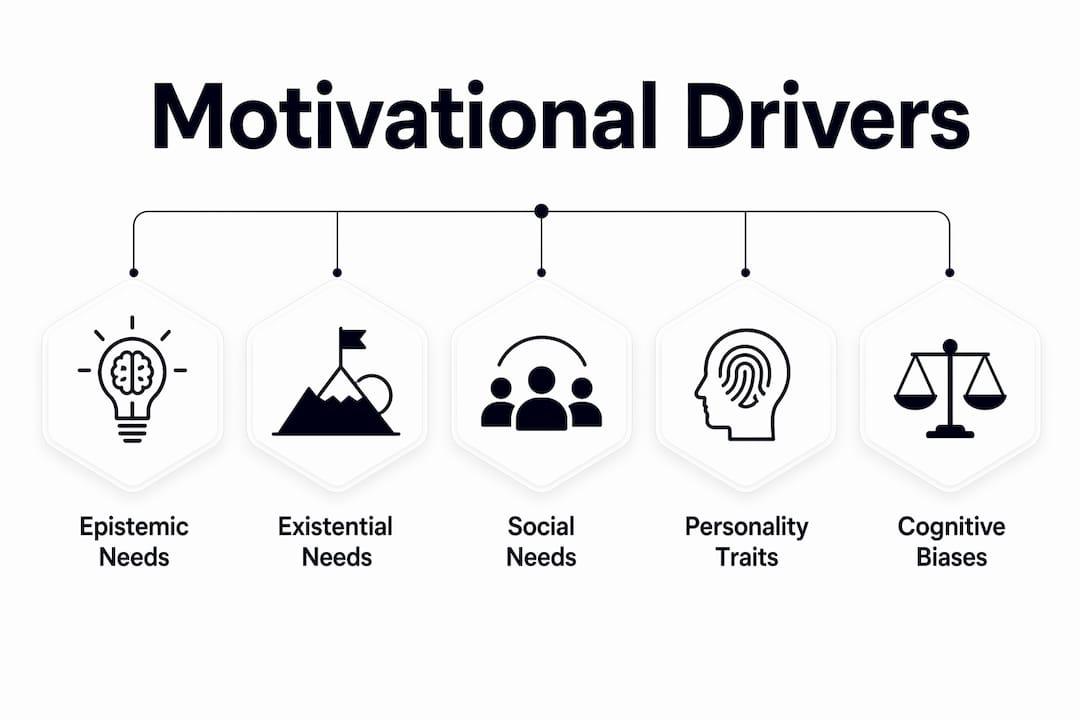
People don’t believe conspiracy theories because they’re foolish. They believe them because their minds are doing exactly what minds are built to do: seek order, restore control, and find belonging. A meta-analysis of 279 studies involving 137,406 participants, conducted by researchers including Karen M Douglas, Robbie M Sutton, and Aleksandra Cichocka, confirms that conspiracy belief is primarily driven by three classes of unmet psychological need:
- Epistemic motives: the drive to understand, find certainty, and make sense of a chaotic world
- Existential motives: the need to feel safe, in control, and protected from threat
- Social motives: the desire to belong, to feel valued, and to see one’s group as righteous
The American Psychological Association and the National Institutes of Health have both recognized this motivational framework as the most empirically supported account of why people believe in conspiracies. The research is unambiguous: conspiracy thinking is not a symptom of ignorance. It is a symptom of frustrated need.
What does conspiracy theory psychology actually tell us?
The field of conspiracy theory psychology examines why ordinary people, under ordinary pressures, adopt extraordinary explanations. Researchers at institutions including Cornell University and the University of Kent have spent decades mapping the cognitive and emotional terrain that makes conspiratorial thinking feel not just plausible, but necessary.
The science consistently shows that conspiracy beliefs are not random. They cluster around moments of uncertainty, loss of control, and social threat. The APA’s research frames conspiracy theories as “neat explanations†that offer subjective certainty precisely when reality feels most ambiguous. That appeal is not a flaw in human reasoning. It is a feature of a cognitive system optimized for survival in a world that rarely offered clean answers.
Epistemic motives: the hunger for certainty
The need to understand is one of the most powerful forces in human cognition. When that need goes unmet, conspiracy theories rush in to fill the gap.
Epistemic motives center on the drive to feel informed, to perceive patterns, and to achieve what psychologists call cognitive closure. When a major event- a pandemic, an assassination, a financial collapse- seems too large or too random to have a simple cause, the mind resists. Conspiracy theories resolve that discomfort by offering a single, unified explanation that accounts for everything. As research confirms, these theories help people regain a sense of meaning in chaotic environments.
Key epistemic drivers include:
- Intolerance of uncertainty: a low threshold for ambiguity that makes incomplete explanations feel threatening
- Pattern recognition overdrive: the tendency to detect agency and intention even in random events
- Need for cognitive closure: a preference for definitive answers over open questions
- Epistemic frustration: the sense that official sources are withholding or distorting the truth
The stronger these epistemic needs, the more attractive a conspiracy theory becomes, not because the theory is credible, but because it is complete.
Existential motives: when powerlessness demands an answer
Feeling powerless is psychologically intolerable. Conspiracy theories offer a strange but effective remedy: if someone is in control, even a malevolent someone, then the world is not purely random.

Research published in Political Psychology demonstrates that existential motives, including anxiety, powerlessness, and social alienation, are strongly linked to conspiracy belief. The logic is counterintuitive but consistent: believing that a shadowy elite orchestrates world events is, in a perverse way, more comforting than accepting that catastrophe can strike without cause or warning. Conspiracy belief restores a sense of agency by naming the enemy and implying that the truth, once known, can be acted upon.
Specific existential drivers include:
- Perceived lack of control: feeling that external forces govern one’s life and outcomes
- Existential anxiety: generalized fear about safety, mortality, or social stability
- Alienation: a sense of disconnection from mainstream institutions and social structures
- Threat to the social order: the perception that one’s community or way of life is under attack
These motives don’t require a person to be mentally ill or politically extreme. They require only that a person feel, at some level, that the world is not safe and that they cannot trust the systems meant to protect them.
Social motives: belonging, identity, and the need to feel special
Conspiracy beliefs rarely exist in isolation. They thrive in communities, and those communities serve a function unrelated to truth-seeking.

The same meta-analysis that identified epistemic and existential motives found equally strong evidence for social drivers. People use conspiracy beliefs to maintain a positive image of themselves and their groups, to signal that they see through deception that others miss, and to reinforce bonds with those who share their worldview. This is not cynical manipulation. It is the ordinary psychology of group identity, applied to extraordinary claims.
Social motives driving conspiratorial thinking include:
- In-group solidarity: shared belief creates cohesion and mutual trust among members
- Out-group suspicion: the belief that powerful outsiders, elites, governments, or corporations are the source of threat
- Uniqueness motivation: the desire to possess knowledge that most people lack, which confers status
- Positive group image: conspiracy beliefs can frame one’s community as morally superior or uniquely perceptive
- Social threat response: when a group feels marginalized or attacked, conspiratorial narratives provide both explanation and solidarity
Cornell University researchers have documented that conspiracy theorists frequently overestimate how widely their beliefs are shared, a cognitive distortion that reinforces the sense of belonging to a knowing minority rather than an isolated fringe.
Personality traits and cognitive biases that predict conspiracy belief
Not everyone who feels uncertain or powerless becomes a conspiracy theorist. Certain personality profiles and cognitive patterns make some people significantly more susceptible.
Studies published in PLOS ONE link conspiracy belief to traits including paranoia, narcissism, antagonism, and impulsivity, as well as to Cluster A and Cluster C personality disorder profiles. Narcissism, in particular, connects to the uniqueness motivation: the belief that one possesses special insight unavailable to ordinary people. Antagonism, the disposition toward suspicion and hostility, makes it easier to attribute malicious intent to institutions and authority figures.
Cognitive biases compound these traits. Research using machine learning analyses found that psychological traits like narcissism and anomie predict conspiratorial predispositions more reliably than political affiliation, education level, or demographic variables. The conspiratorial mindset, a generalized tendency to suspect hidden agendas, functions as a stable disposition that predicts future belief adoption across a wide range of specific theories.
Key traits and biases associated with conspiracy endorsement:
- Overconfidence: conspiracy believers tend to overestimate how many others share their views
- Anomie: a sense that social norms have broken down and institutions cannot be trusted
- Paranoia: a chronic tendency to perceive threat and hostile intent in ambiguous situations
- Proportionality bias: the assumption that large events must have large, intentional causes
- Schizotypy: a personality dimension involving unusual perceptual experiences and magical thinking
The generalized conspiratorial mindset is not simply agreement with a particular theory. It is a cognitive orientation, a lens through which ambiguous information is consistently interpreted as evidence of concealment.
What the scientific consensus says, and where research is heading
The psychological research community has reached substantial agreement on the motivational framework. Epistemic, existential, and social motives are the primary drivers of conspiracy belief, and their effects are consistent across cultures, political systems, and demographic groups. The meta-analysis of 279 studies found significant effect sizes across all three motive classes, with existential and social motives showing slightly stronger associations than epistemic ones.
Several important questions remain open. Researchers debate whether conspiracy beliefs actually satisfy the needs that drive them, or whether they deepen frustration over time. The “monological belief system†model, the idea that conspiracy theories form a coherent, self-reinforcing worldview, has been challenged by evidence that believers often hold theories that contradict each other. What unifies them is not logical consistency but a shared underlying mistrust of official accounts.
Ongoing research priorities include:
- Causal evidence: most existing studies are correlational; experimental designs are needed to confirm that frustrated motives cause belief adoption
- Longitudinal tracking: understanding whether conspiracy belief alleviates or amplifies unmet needs over time
- Cross-cultural variation: examining how WEIRD sample bias (Western, Educated, Industrialized, Rich, Democratic) has shaped existing findings
- Measurement standardization: the field still lacks consensus on how to operationalize and compare conspiracy belief across studies
Expert insights from Mergedinsight’s multidisciplinary research archives
The psychological mechanisms behind conspiracy thinking did not emerge from nowhere. They evolved.
Pro Tip: When you encounter a conspiracy theory that feels intuitively compelling, ask yourself which need it is meeting. Is it offering certainty in an uncertain situation? Restoring a sense of control? Connecting you to a community? Identifying the need doesn’t make the theory true, but it does make your own reasoning visible.
Evolutionary psychologists, drawing on work published in Perspectives on Psychological Science, argue that humans evolved a coalitional detection system, a mental module for identifying hidden threats from rival groups. In ancestral environments, this system saved lives. In modern information environments saturated with ambiguous signals, it can misfire, generating conspiracy beliefs where no real conspiracy exists. The coalitional mind hypothesis distinguishes between proximal mechanisms like pattern recognition and a higher-order adaptive conspiracism function, a distinction that helps explain why conspiracy thinking is so widespread and so resistant to correction.
Karen M Douglas, whose work at the University of Kent anchors much of the motivational framework, and colleagues including Robbie M Sutton and Aleksandra Cichocka, have consistently argued that conspiracy beliefs fulfill complex psychological needs. The APA’s recognition of this framework reflects a broader scientific consensus: conspiracy thinking is not a failure of intelligence. It is a miscalibrated response of a cognitive system doing its best under conditions of stress, uncertainty, and social threat. Mergedinsight’s psychology coverage explores these mechanisms in depth, tracing how research from social, cognitive, and evolutionary psychology converges on this conclusion.
How early life and environment shape conspiracy thinking
Conspiracy beliefs don’t appear fully formed in adulthood. They are shaped by developmental experiences and environmental conditions that begin accumulating early.
Childhood exposure to institutional betrayal, whether through family dysfunction, community trauma, or direct experience of government or institutional failure, builds the foundational mistrust that conspiracy theories later exploit. Environments characterized by chronic uncertainty, economic precarity, or political instability produce adults whose epistemic and existential needs are chronically frustrated. Research consistently shows that people who grew up in low-trust environments are more likely to interpret ambiguous events through a conspiratorial lens later in life.
Cultural context also matters. Societies with histories of genuine state deception, surveillance programs, or political persecution tend to produce higher baseline levels of institutional distrust. In those contexts, conspiratorial thinking is not irrational. It is a learned adaptation to an environment where official accounts have historically been unreliable. The challenge for researchers is distinguishing adaptive skepticism from the miscalibrated pattern detection that produces false conspiracy beliefs.
How media consumption drives conspiratorial thinking
The information environment a person inhabits shapes their beliefs as powerfully as any personality trait. Research using machine learning found that sharing false information online correlates with conspiracy thinking more strongly than simple social media use. Time spent on platforms like Instagram and YouTube shows a moderate correlation with conspiratorial predispositions, but the act of actively spreading misinformation is the stronger signal.
Algorithmic recommendation systems amplify this effect. Platforms optimized for engagement tend to surface content that provokes strong emotional responses, and conspiracy content reliably delivers outrage, fear, and the satisfaction of revealed secrets. Mergedinsight’s digital analysis has tracked how these platform dynamics create feedback loops: a user who engages with one conspiratorial video is systematically shown more, gradually normalizing a worldview built on hidden agendas and institutional deception.
Traditional media also plays a role. Outlets that consistently frame events as the product of elite manipulation, without evidence, prime audiences to interpret subsequent events through the same lens. Media literacy, the ability to evaluate sources, recognize emotional manipulation, and distinguish evidence from assertion, is one of the most consistent protective factors researchers have identified.
Strategies that actually reduce conspiracy belief
Correcting conspiracy beliefs is genuinely difficult, and approaches that target misinformation directly often backfire. The meta-analytic evidence is clear: effective interventions must address the underlying frustrated psychological motives, not just the false claims themselves.
Approaches with empirical support include:
- Inoculation: pre-emptively exposing people to weakened forms of conspiratorial arguments, along with refutations, before they encounter the full version. Cornell University researchers have explored inoculation as a tool to limit election misinformation, with promising results.
- Analytic thinking prompts: encouraging deliberate, evidence-based reasoning reduces reliance on intuitive pattern detection, one of the core cognitive mechanisms behind conspiracy endorsement.
- Need satisfaction: addressing the underlying epistemic, existential, or social need directly, by restoring a sense of control, providing genuine community, or offering credible explanations for uncertainty.y
- Motivational interviewing: non-confrontational dialogue techniques that explore a person’s own doubts without triggering defensive entrenchment
- Media literacy education: building the skills to evaluate sources and recognize manipulation, particularly effective when introduced early in life
What does not work is ridicule. Mocking conspiracy believers reinforces their sense of persecution and deepens their commitment to the in-group that validates their worldview.
How conspiracy beliefs affect mental health and social behavior
The psychological costs of sustained conspiracy belief are real and measurable. People who hold strong conspiracy beliefs report lower levels of institutional trust, reduced civic participation, and greater social isolation. The beliefs that initially serve as a coping mechanism, restoring a sense of control or belonging, can over time deepen the very alienation they were meant to relieve.
Mental health consequences include heightened anxiety, as the conspiratorial worldview is inherently threatening, and a chronic sense of powerlessness, since the forces imagined as being in control are by definition beyond the individual’s reach. Social behavior shifts too: conspiracy believers are less likely to vote, less likely to comply with public health guidance, and more likely to withdraw from mainstream social institutions. At the community level, widespread conspiracy belief erodes the shared epistemic foundation that democratic deliberation requires. When citizens cannot agree on basic facts, collective action becomes nearly impossible, and the social fabric frays in ways that are difficult to repair.
Key Takeaways
Conspiracy belief is driven by unmet psychological needs for certainty, control, and belonging, not by ignorance or irrationality, and effective responses must address those underlying needs directly.
| Point | Details |
|---|---|
| Three core motives | Epistemic, existential, and social needs drive conspiracy belief, confirmed across 279 studies. |
| Personality predicts belief | Traits like narcissism and anomie predict conspiratorial thinking more reliably than political or demographic factors. |
| Media amplifies risk | Sharing false information online correlates with conspiracy thinking more strongly than passive social media use. |
| Interventions must target needs | Correcting misinformation alone fails; effective strategies address the frustrated psychological motives underneath. |
| Mental health costs are real | Sustained conspiracy belief deepens anxiety, social isolation, and civic disengagement over time. |
A Merged Insight Exclusive.