
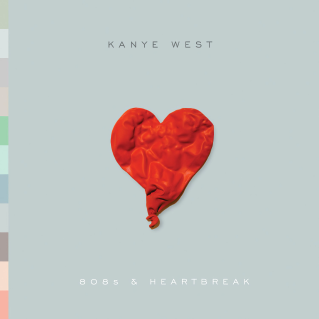
In the grand, sprawling architecture of Kanye West’s discography, there is a distinct, irrevocable line drawn in the snow. On one side lies the warm, soulful, sample-heavy triumph of his initial trilogy—a run of albums defined by pitched-up R&B vocals, stadium-shaking anthems, and an ego that seemed capable of bending the world to its will. On the other side lies the dark, experimental, and chaotic brilliance of his later career. But standing directly on the fault line, bridging the gap between the man he was and the myth he would become, is 808s & Heartbreak.
Released in November 2008, it is not merely a transitional record. It is Kanye West’s absolute magnum opus.
To understand why 808s & Heartbreak stands as his greatest achievement, one must look beyond its tracklist and examine the profound synthesis of music and reality that it represents. It is an album where the artificiality of electronic production perfectly mirrors the brutal, isolating reality of human grief. It is the sound of a fractured psyche utilizing cold, synthetic tools to process a reality that had become entirely unrecognizable.
The Fracture of the Reality Principle
To grasp the synthesis at play, we must first confront the reality that birthed the music. By late 2007, Kanye West had achieved everything he had ever promised he would. With Graduation, he had definitively defeated 50 Cent in their infamous sales battle, proving that the future of hip-hop belonged to the vulnerable, the artistic, and the eccentric. He was at the absolute zenith of global superstardom.
And then, his reality collapsed.
In November 2007, his mother, manager, and emotional anchor, Dr. Donda West, passed away suddenly following surgical complications. Months later, his engagement to his long-time fiancée, Alexis Phifer, dissolved. In the span of a few months, the two most important women in his life were gone. The reality of his unprecedented fame was violently juxtaposed against the reality of his profound, inescapable isolation.
Until this point, Kanye’s music had functioned as a reality-distortion field. Through sheer force of will, clever lyricism, and triumphant soul samples, he could project a reality of success, defiance, and joy. But grief of this magnitude cannot be distorted; it can only be endured. The triumphant horns of “Touch the Sky” or the gospel warmth of “Jesus Walks” were entirely inadequate tools for articulating the profound emptiness he was experiencing.
He needed a new sonic language. He needed a sound that mirrored the cold, cavernous, and synthetic reality of a life that felt suddenly hollow. He found that synthesis in two primary tools: the Roland TR-808 drum machine and Auto-Tune.
The Digital Heartbeat: Synthesizing Physiology
The Roland TR-808 is a legendary piece of hardware in hip-hop and dance music, known for its booming, synthetic bass kicks and sharp, unnatural snares. Historically, the 808 was used to create movement, to shake the trunks of cars, and to fill the dancefloor. On 808s & Heartbreak, Kanye repurposed the machine to synthesize the very rhythm of human suffering.
The drum machine ceases to be a mere rhythmic foundation and becomes a biological metronome. The synthesis of music and reality is perhaps most overt on the album’s lead single, “Love Lockdown.” The track opens not with a melody, but with a stark, thumping 808 kick drum. It does not sound like a traditional drum kit; it sounds exactly like a rapid, panicked human heartbeat echoing in an empty room.
By utilizing the 808 to mimic his physiological state, Kanye synthesized his internal reality with his external medium. The drums on the album—often saturated in reverb and given wide, space in the mix—reflect the physical reality of a panic attack, the heavy chest of depressive episodes, and the relentless, mechanical marching of time when one is trapped in mourning. The music is stripped of its organic warmth. There are very few traditional samples. Instead, the reality of a cold world is mirrored by cold synthesizers, plinking pianos, and tribal, synthetic percussion.
The Cyborg Soul: Auto-Tune as Emotional Armor
If the 808 provided the heartbeat of this new reality, Auto-Tune provided the voice. Before 2008, Auto-Tune in hip-hop and R&B was primarily utilized as a polishing tool to correct off-key vocals, or by artists like T-Pain as a stylistic, futuristic flourish. It was a tool of perfection and party anthems.
Kanye West weaponized it to express human frailty.
On 808s & Heartbreak, Kanye cannot rap. The reality of his emotional state renders the aggressive, confident cadence of traditional hip-hop entirely false. Instead, he sings—but he is not a trained vocalist. By filtering his raw, untrained, and often strained voice through heavy Auto-Tune, he creates a jarring synthesis between man and machine.
This is the sound of the “cyborg soul.” The Auto-Tune on tracks like “Heartless” and “Street Lights” acts as a digital armor, a synthetic barrier erected by a man who is too deeply wounded to present his unvarnished self to the world. Yet, paradoxically, the software only highlights his vulnerability. As he pushes his vocal cords beyond their natural capability, the pitch-correction algorithm struggles to lock in, resulting in a fractured, robotic wail. We hear the machine breaking under the weight of human emotion.
This is a masterclass in the synthesis of form and content. The reality of Kanye’s alienation—his feeling of being fundamentally disconnected from the human experience due to grief and fame—is perfectly synthesized by a vocal effect that literally dehumanizes his voice. He sounds like a ghost trapped in the mainframe of his own superstardom.
The Architecture of Emptiness
The lyrical composition of 808s & Heartbreak further perfects this synthesis. Pre-2008 Kanye was characterized by his dense, punchline-heavy, hyper-referential rapping. He was a maximalist with words. But the reality of profound depression is that it is rarely poetic; it is repetitive, exhausting, and circular.
The lyrics on the album abandon complex rhyme schemes in favor of blunt, agonizing mantras. On “Say You Will,” the lyrics are sparse, floating over a vast, echoing choir and an endless, ticking drum machine. He asks, “Why would she make calls out of the blue? / Now I’m awake, sleepin’ on you.” The repetition mirrors the obsessive, looping thoughts of a mind trapped in the immediate aftermath of a breakup. The song stretches for over six minutes, with the final three minutes devoid of any vocals at all—just the relentless, cold pulsing of the beat. The negative space in the music is a direct translation of the physical absence of the people he has lost.
Similarly, on “Coldest Winter,” a direct elegy to his mother, the lyrics are devastatingly simple: “Goodbye, my friend, will I ever love again? / Memories made in the coldest winter.” He doesn’t attempt to intellectualize the loss. The reality of the pain is absolute, and the music—driven by a heavy, tribal drum beat and a haunting sample of Tears for Fears—synthesizes the stark finality of death.
“Pinocchio Story” and the Ultimate Collision
The absolute zenith of this synthesis between music and reality occurs on the album’s closing track, “Pinocchio Story.” Unlike the rest of the meticulously produced album, this track is a raw, unmastered live recording captured at a concert in Singapore.
In this freestyle, Kanye wails over a rudimentary drum loop, completely abandoning any traditional song structure. He compares himself to Pinocchio, possessing everything a pop star could want (the clothes, the cars, the fame) but lacking the one thing that matters: a real life, a real family, the ability to be a “real boy.”
What makes “Pinocchio Story” the most profound moment of the album—and perhaps of his entire career—is the terrifying juxtaposition of his reality against the audience’s reality. As Kanye screams in agony about the death of his mother and the hollowness of his existence, the crowd screams back in adoration. They cheer at his pain. The audience consumes his literal breakdown as entertainment.
In this singular, harrowing track, the boundary between the music and the reality of the artist completely dissolves. The live recording captures the grotesque nature of modern celebrity, synthesizing Kanye’s internal nightmare with the external reality of a stadium full of people who love the idol but cannot see the man. It is a live-action documentation of the very alienation the rest of the album attempts to describe in a studio setting.
The Blueprint of Modern Music
The greatness of 808s & Heartbreak is not just in how accurately it synthesized Kanye West’s reality at that specific moment in time; it is in how that synthesis reshaped the reality of popular music forever.
When the album was released, it was met with severe polarization. The hip-hop establishment was baffled by the lack of rapping, the pervasive Auto-Tune, and the unabashed emotional bleeding. It violated the established reality of what a rap superstar was permitted to do. Yet, in breaking his own reality down to its synthetic, rhythmic studs, Kanye accidentally provided the blueprint for the next two decades of music.
Without the synthesis achieved on 808s & Heartbreak, there is no Drake. There is no Weeknd. There is no Kid Cudi, Juice WRLD, Lil Uzi Vert, or Travis Scott. The album proved that hip-hop could be driven entirely by melody and vulnerable, atmospheric mood rather than aggressive lyricism. It proved that the synthesis of cold, electronic R&B and deeply personal, depressive songwriting could resonate on a global scale.
808s & Heartbreak remains Kanye West’s best album because it is his most necessary album. It is not an album born of a desire to prove his lyrical supremacy, nor is it a conceptual art project designed to provoke. It was a matter of spiritual survival. By taking the harshest, coldest reality of his life and synthesizing it through the microchips of a Roland drum machine and the algorithms of pitch-correction software, he turned his ultimate defeat into a triumphant, immortal work of art. The reality was shattered, but the music it created is unbreakable.
A Merged Insight Exclusive.