If you were sitting in a movie theater in 2024, the idea of artificial intelligence in cinema was most likely framed in two ways: as the literal, apocalyptic villain on screen (as seen in The Creator or Mission: Impossible – Dead Reckoning) or as the meta-villain behind the scenes, threatening to replace writers, actors, and artists during the historic Hollywood strikes.
What a difference two years make.
As we move through 2026, the conversation about AI integration in films has dramatically shifted. It’s no longer defined primarily by fear of replacement. Instead, the narrative is about synergy, acceleration, and a powerful, if sometimes unsettling, democratization of the storytelling process.
AI has graduated from an experimental parlor trick to an essential, quiet engine powering every stage of the cinematic pipeline. It has moved beyond the “uncanny valley” where digital faces felt wrong, and deep into the architecture of world-building itself.
To understand the scope of this evolution, we must analyze how AI went from a disruptive force to the invisible collaborator defining the current era of film production.
The Evolution of the Virtual Set
The most immediate and visible impact of AI is in the realm of visual effects (VFX) and production design, where the old paradigm of “fixing it in post” has been replaced by “perfecting it on set.”
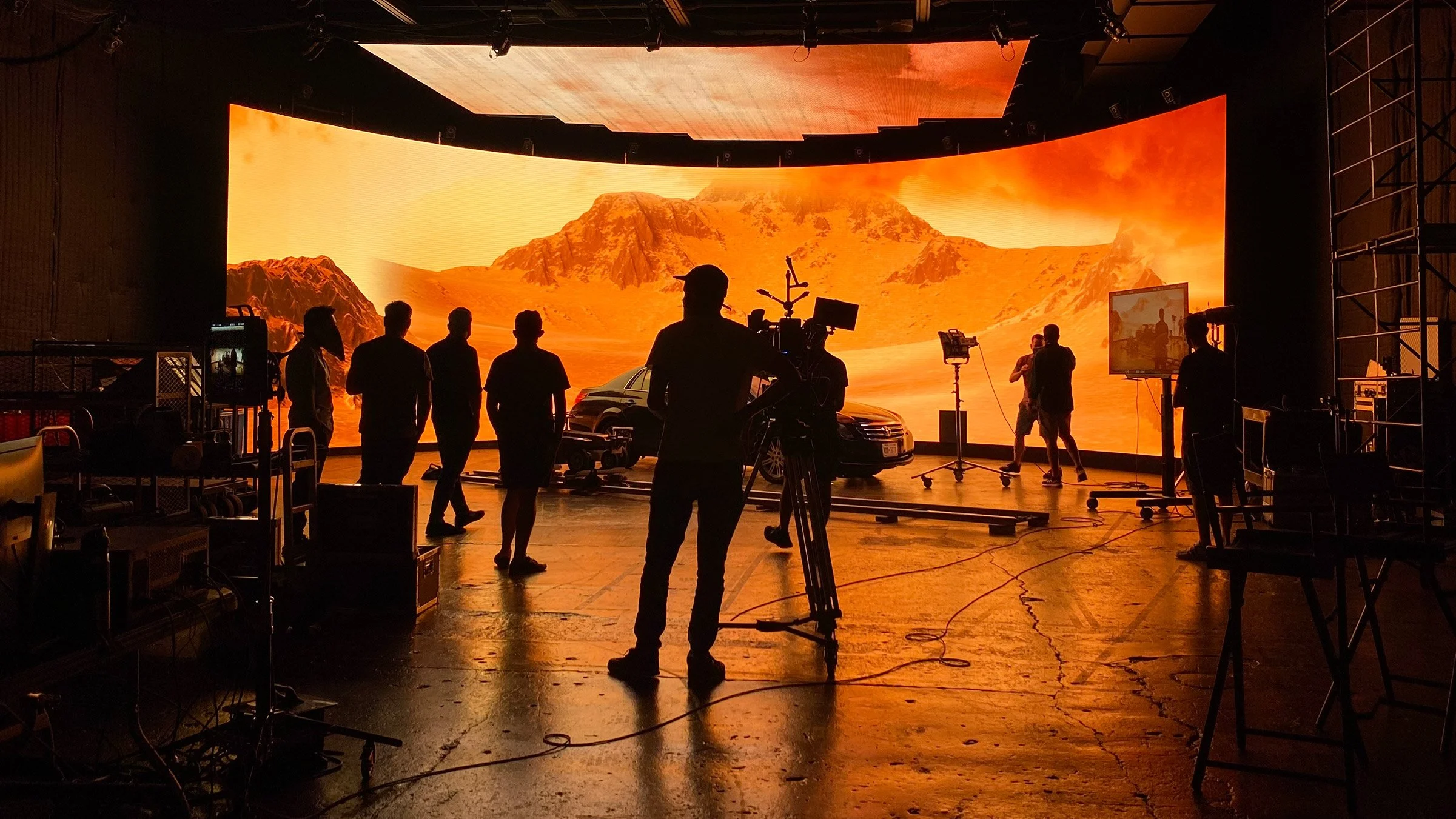
In the early 2020s, technologies like the ILM StageCraft “Volume” (famously used in The Mandalorian) popularized the use of real-time LED walls. However, the graphics on those walls were largely pre-rendered.
By 2026, AI will have supercharged this concept. Companies are now deploying generative AI models that can generate 3D assets and photorealistic backgrounds on demand and in real-time. If a director decides during a shoot that a scene in a desert needs an oasis, they don’t need to stop for a three-hour asset rebuild. They can describe the change to an AI-integrated system, and the digital background updates dynamically.
This integration allows for unprecedented creative flow, reducing the gap between initial thought and final frame. Production design has shifted from modeling objects to “prompt engineering” entire ecosystems, making the creation of the complex alien worlds required for films like Dune: Part Three (2026) both faster and visually richer.
Performance: Precision, Not Replacement
The conversation about “digital actors” has perhaps seen the largest transformation. The ethical debates that defined 2023 were crucial, resulting in strict regulations regarding the digital replication of likenesses. However, those regulations created the groundwork for ethical, precision-based AI integration.
The goal in 2026 isn’t to replace the actor, but to enhance and expand their reach. We see this in several key areas:
- Digital “Cosmetics” and Age Correction: While “de-aging” existed before, it often required months of painstakingly detailed work, sometimes resulting in robotic-looking movements. Modern AI algorithms handle the temporal consistency (matching the movement of skin and muscle over time) automatically. This has refined the “age correction” technique, allowing actors to play roles across vastly different ages in the same film without requiring thousands of artists and massive budgets.
- Perfect, Emotional Dubbing: This is perhaps the most significant change in how global audiences experience films. Traditional dubbing is limited by the disconnect between the new dialogue and the actor’s existing lip movements. AI-powered localized vocal synthesis and lip-syncing—such as those popularized by the company Flawless—can now synchronize an actor’s performance precisely with any language. When an actor in Project Hail Mary (2026) is dubbed into Spanish, the digital algorithm adjusts their actual mouth movements, so they appear to be speaking Spanish natively, preserving the nuances of their original performance.
This technology has dissolved cultural and linguistic barriers, creating a truly global audience that can engage with a story emotionally, rather than tolerating an awkward translation.
The Algorithm in the Writer’s Room
This is where the fear of “AI writers” was strongest. However, the reality of 2026 is that AI is not drafting final scripts for major motion pictures. (Indeed, audiences showed significant resistance to purely “synthetically written” content).
Instead, generative AI is functioning as the ultimate research assistant and sounding board. Writers are using advanced Language Learning Models (LLMs) to:
- Optimize Structure: A writer can input their first draft and ask the AI to analyze the pacing, identify logical dead ends, or flag where characters seem out of character. It provides objective, structural feedback, acting as a tireless script editor.
- Deep Research and Lore Management: For massive franchise projects like Avengers: Doomsday (2026), managing decades of comic book lore and previous MCU continuity is a logistical nightmare. AI can maintain a “perfect memory” of all previous plot points and rules, flagging potential contradictions as the writers develop the new story.
- Brainstorming and Dialogue Spooling: While an AI cannot match a human’s understanding of irony or subtext, it can instantly generate thousands of options for “bad dialogue” (generic responses) that writers can use to quickly outline a scene before going back to inject the genuine emotional resonance.
This integration has shortened the critical window of script development, helping to manage the immense scheduling pressure that defined blockbuster filmmaking.
The New Post-Production Efficiency
The “mid-to-late” stages of production, historically some of the most labor-intensive parts of filmmaking, have been completely upended by AI automation.
- Editing and Rushes: AI systems are used to process “rushes” (the raw footage shot each day). They can automatically catalog shots by angle, camera setting, specific actors present, and even analyze the emotional intensity of a take. This means an editor doesn’t spend days organizing footage; they arrive at the studio with the best options for a scene already organized and ready to compile.
- Sound Mixing and Scoring: AI models are now skilled at automatically cleaning up noisy audio tracks, essential for filming in public locations. More surprisingly, AI is assisting composers like Hans Zimmer. A composer can now feed a basic musical motif into an AI model and ask it to generate dozens of orchestral variations in the “style” of the score, providing a rapid-fire library of cues that the human composer then curates and polishes.
- Marketing and Localization: AI can analyze a final cut of a film and instantly generate hundreds of unique marketing assets—including trailers optimized for different social media platforms, poster designs, and key art, all specifically targeted toward different demographic data points.
The Future: Personalized Cinema?
Perhaps the most radical frontier we are beginning to see in late 2026 is “hyper-personalized” cinema. This is still experimental, but the groundwork is being laid.
This concept uses AI to generate content dynamically based on viewer data. This could include:
- Personalized Recaps: When streaming a complex story, an AI could analyze the user’s previous viewing history and generate a custom “previously on” summary that only highlights the specific plot points they need to remember.
- Modular Dialogue: In specific interactive or “choose your own adventure” style releases, AI can generate new character dialogue options on the fly, allowing the narrative to branch almost indefinitely based on user choices, all while keeping the digital performance photorealistic.
This points to a potential future where the definition of a “final cut” becomes fluid, challenging the very idea of a shared, singular audience experience.
Conclusion: The New Partnership
As we navigate 2026, it’s clear that AI is not the replacement of human creativity, but its amplification. The “uncanny valley” of fear has been crossed.
The true definition of integration in 2026 is not visible on screen. It’s the invisible automation, the accelerated workflow, and the seamless global translation. AI has allowed filmmakers to bypass the logistical and financial bottlenecks that historically stalled massive projects, shifting the focus back to the core element that machines cannot yet replicate: genuine emotional storytelling.
The best films of 2026 will still be defined by their visionaries. But those visionaries are now operating with an engine more powerful, adaptable, and collaborative than anything that came before. AI is not the end of cinema; it is the beginning of its next, most expansive chapter.